The platform

What AxiumOne does

An ERP platform your team shapes to the way it already works — configured in the browser, governed from day one, and running on infrastructure you choose.

Configure, don't code

Model your business, not a vendor's idea of it

Define what you actually work with — orders, assets, inspections, whatever your operation calls them — and the platform builds the tables, forms and grids to match.

Your own business objects
Add an object and its fields, and the tables, forms, grids and API appear with it. No release cycle, no developer.
Numbering and validation you control
Automatic document numbers, required and unique values, formats and input masks — set per field, enforced by the server.
Calculations and linked records
Totals that compute themselves, and fields pulled from a linked record — copied as at the time of the document, or always current.
Documents with headers and lines
Transactional documents with their own status lifecycle, so a posted order behaves differently from a draft one.
Rules and automation
Price and value lookups from decision tables, and actions that fire when a record is created, changed or reaches a status.
Stock movements, where you need them
Receipts, issues, transfers between branches and cycle counts, with balances kept per location.
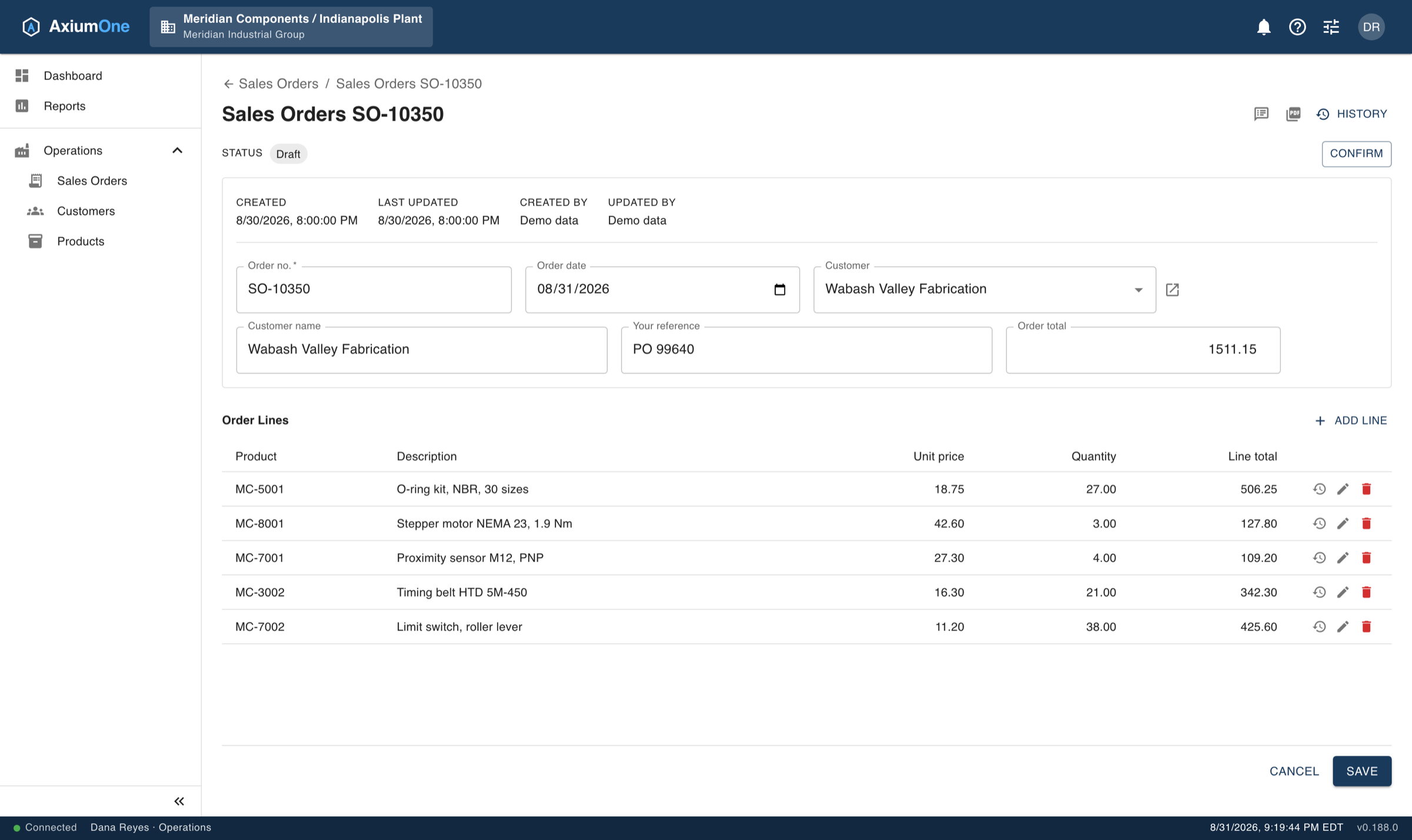
A sales order in AxiumOne: header fields including customer and order date, a Draft status with a Confirm action, five order lines with unit price, quantity and line total, and an order total calculated from the lines.
A sales order built from the pieces above: fields you defined, a status that gates what can happen next, lines of their own, and a total the server calculates rather than trusts.
Multi-tenant by design

Governance that was there from the first record

Separation between organizations, companies and branches is built into the foundation rather than bolted on — so who sees what is a setting, not a project.

Organizations, companies, branches
Every record carries its place in the hierarchy, and every query respects it automatically.
Access down to the field
Grant a role a whole object, or make one column read-only or invisible to it. Enforced on the server, not hidden in the browser.
A complete change history
Every change to every record, with the old value, the new value, who made it and when.
A view across the whole company
Give oversight and reporting roles a read-only branch that sees every location at once, without the ability to change anything.
Two-factor authentication
Optional for users, enforceable for administrators or across an entire organization.
Nothing disappears by accident
Deletions are recoverable, and an administrator can see exactly what a role can reach before granting it.
Insight built in

Answers from your own data, without a data project

Reporting runs over the same records your team works in every day — scoped to what each person is allowed to see, with no extract, no warehouse and no waiting.

Build a report without SQL
Pick columns, filter, sort, group and total. Save it, and share it with the roles that should have it.
Scheduled and delivered
Have a report run on a schedule and arrive by email, or post to another system automatically.
Figures on the dashboard
Live key figures with trends, shown to the roles that need them and scoped to each person's own context.
Documents on your letterhead
Print any record or report to PDF with your own logo and address, formatted for the reader's language and locale.
Your data stays yours

Software that talks to nobody but you

Where your data lives, and what touches it, is a decision you make — not one the software makes for you.

No telemetry, no tracking, no third parties
The application makes no outbound connection except to the mail server you nominate. Nothing is sent to us, and nothing is sent to anyone else.
Real tables in a real database
Your data sits in ordinary SQL tables, readable by your own BI and reporting tools. Nothing is locked in an opaque format.
Hosted, or on your own servers
Run it as a service, or in your own data centre. The product is the same either way.
Open to your other systems
A REST API, keys for machine access, and webhooks that notify another system the moment something changes.
Backed up, and yours to take
Automated backups with off-site copies, and a full export of an organization's data whenever you ask for it.
Eight languages, and room for more
English, German, Spanish, French, Italian, Portuguese, Dutch and Polish — including the administration screens, not just the surface. Translations are data rather than compiled resources, so a further language can be added without a new release.
Everyone in their own time zone
Each person sees times where they are, and a scheduled report arrives at the local hour it was set for — on both sides of a daylight-saving change.

See it against your own process

The quickest way to judge a platform like this is to point it at something you actually do. Bring us a process and we will show you how it would be configured.

Book a demo